Difference Between Attar and Perfume
Walk into any fragrance shop in Pakistan and you’ll face an immediate choice — should you buy attar or perfume?…
Every Muslim wants a connection with Allah. Every Muslim faces hardship, worry, and need. Wazaif are one of the most powerful tools Islam gives us to maintain that connection and seek Allah’s help in difficult times.
In Pakistan, Wazaif are part of daily Muslim life. Mothers recite them for their children. Students recite them before exams. Business owners recite them for barakah in their work. But very few people truly understand what Wazaif are, where they come from, and how to use them correctly.
This blog gives you a complete, authentic, and easy-to-understand guide on Wazaif in Islam. You will learn their definition, their types, their benefits, proper etiquette, common mistakes, and where to find reliable Wazaif books.
The word Wazaif is the plural of Wazifa in Arabic. The root word comes from wazafa, which means to assign or to appoint a task regularly. In Islamic practice, a Wazifa is a specific Quranic verse, Dua, or Dhikr that a Muslim recites a set number of times at a set time with a specific intention.
Wazaif are not random prayers. They are structured, intentional acts of worship. They connect the person directly to the words of Allah or the Sunnah of the Prophet (PBUH). This is what separates authentic Wazaif from superstition or cultural practice.
Imam Al-Ghazali, in his landmark work Ihya Ulum al-Din, described regular Dhikr and structured supplications as among the highest forms of worship a person can maintain. He emphasised that consistency in remembrance is more beloved to Allah than large but irregular acts of worship.
In simple terms, think of a Wazifa as a spiritual prescription. Just like a doctor gives a specific medicine in a specific dose at a specific time, a Wazifa prescribes specific words of Allah in a specific amount at a specific time for a specific purpose.
Wazaif are not a cultural invention. They are deeply rooted in the Quran and the authentic Sunnah of the Prophet (PBUH).
Allah says in Surah Al-Baqarah (2:152), so remember Me and I will remember you. Be grateful to Me and do not be ungrateful. This direct command from Allah to engage in regular remembrance is the foundational basis for all Wazaif.
In Surah Al-Ahzab (33:41-42), Allah commands believers to remember Him abundantly and to glorify Him morning and evening. The word abundantly here points to repetition and consistency, which is exactly what structured Wazaif provide.
The Prophet (PBUH) himself prescribed specific supplications for specific times and purposes. He taught his companions morning and evening adhkar, supplications before sleeping, after waking, before eating, when entering the home, and dozens of other daily moments. These prescribed supplications form the most authentic and reliable category of Wazaif in Islam.
The hadith collections of Imam Al-Bukhari, Imam Muslim, Abu Dawud, Tirmidhi, and Nasai contain thousands of narrations about the Prophet’s (PBUH) personal Wazaif and those he recommended to his companions. These are the gold standard for authentic Islamic Wazaif.
Not all Wazaif are the same. There are several clearly defined categories. Understanding these categories helps you choose the right Wazifa for the right purpose.
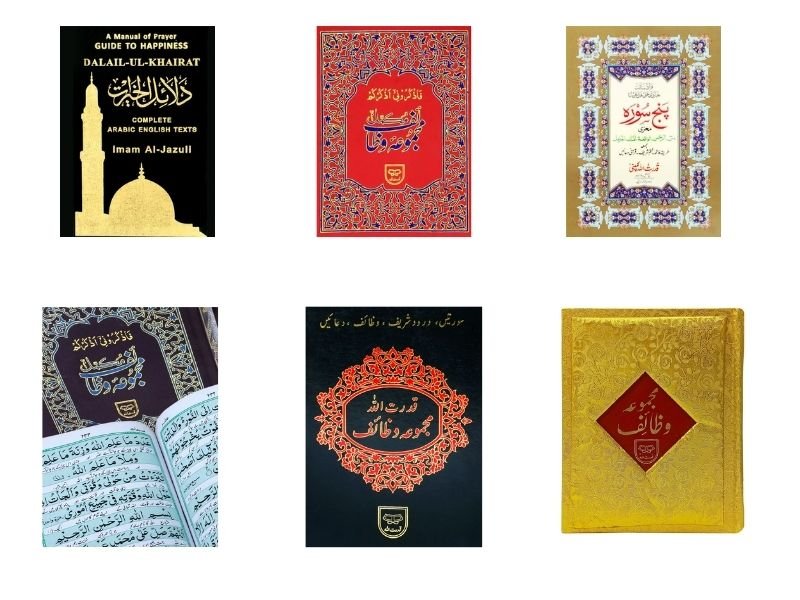
Explore our Wazaif collection for authentic Wazaif books including Majmooa-e-Wazaif, Dalail ul Khairat, Punj Surah, and more trusted titles for daily spiritual practice.
| Wazifa | Source | Common Purpose |
| Ayat ul Kursi | Surah Al-Baqarah 2:255 | Protection after every Salah |
| Surah Al-Mulk | Para 29 | Protection from punishment of the grave |
| Surah Al-Waqiah | Para 27 | Barakah in rizq and sustenance |
| Surah Ar-Rahman | Para 27 | Gratitude and seeking Allah’s blessings |
| Al-Ikhlas x3 | Para 30 | Reward equal to one full Quran |
| Durood Ibrahim | Salah and daily Sunnah | Blessings upon the Prophet (PBUH) |
| Dalail ul Khairat | Imam Al-Jazuli compilation | Daily Durood and Salawat program |
| Asmaul Husna | Quran and Sunnah | Connecting to divine attributes of Allah |
| Majmooa-e-Wazaif | Compiled scholar works | Structured daily Wazaif program |
Dalail ul Khairat is one of the most widely read Islamic texts in the world after the Quran. It was compiled by the Moroccan scholar Imam Muhammad ibn Sulayman al-Jazuli in the 15th century. It contains a structured program of Durood and Salawat upon the Prophet (PBUH) divided into daily sections for the week.
Millions of Muslims across the world, from Morocco to Indonesia to Pakistan, complete Dalail ul Khairat regularly. In Pakistan, it is recited in Sufi circles, in homes, and in mosques. Many scholars consider completing it regularly to be among the most powerful spiritual practices a Muslim can maintain.
The book also contains the 99 Beautiful Names of Allah and descriptions of the Prophet (PBUH). Many Muslims memorise sections of Dalail ul Khairat as part of their daily Wazifa routine.
Get your copy of Dalail ul Khairat from our Dalail ul Khairat collection and start a structured daily Durood program that scholars across centuries have praised and recommended.
Majmooa-e-Wazaif translates to a collection of Wazaif. These are compiled books that bring together multiple Quranic ayahs, Masnoon duas, Asmaul Husna, and Durood into one structured daily program. They serve as a complete spiritual schedule for the reader.
In Pakistan, Majmooa-e-Wazaif books are among the most gifted Islamic publications. Parents give them to newly married couples. Teachers give them to students. Friends gift them to those going through hardship. They are practical, accessible, and deeply valued.
A well-compiled Majmooa-e-Wazaif organises recitations by time of day. Morning Wazaif after Fajr. Evening Wazaif after Asr or Maghrib. Nightly Wazaif before sleep. This structure makes it easy to maintain consistency without needing to search for individual duas or verses.
Browse our Majmooa-e-Wazaif collection for trusted compiled Wazaif books that organise your daily spiritual practice into a clear, easy-to-follow routine.
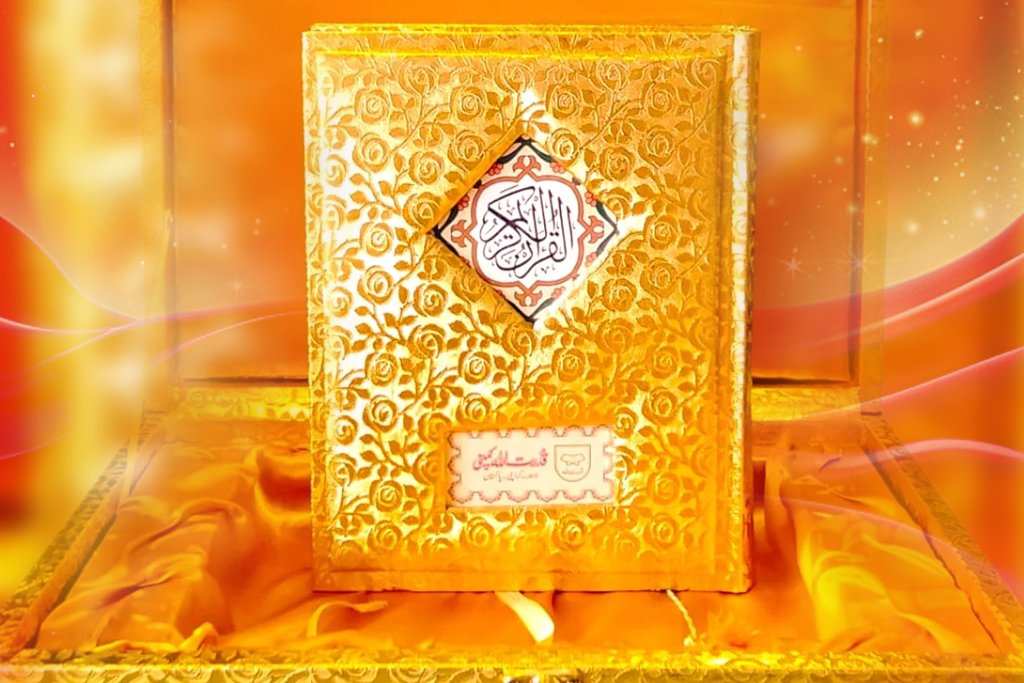
We also carry the exclusive Qudrat Ullah Majmooa Wazaif, a specially curated collection that has served Pakistani Muslim families for generations.
Reciting Wazaif is an act of worship. Like all acts of worship in Islam, it comes with proper etiquette. Following this etiquette increases the spiritual impact and shows respect for the words of Allah and the Sunnah.
Begin with Wudu. Being in a state of purity when reciting Quranic Wazaif is strongly recommended. For Asmaul Husna and Masnoon duas, Wudu is preferred but not always obligatory. However, beginning in a state of purity elevates the entire experience.
Face the Qiblah. Facing the direction of the Kaaba while reciting Wazaif is a Sunnah that many scholars recommend. It aligns your body with the focal point of the Muslim world and deepens concentration.
Start with Bismillah and Durood. Most scholars recommend beginning any Wazifa with Bismillah and sending Durood upon the Prophet (PBUH). This opens the session with the Name of Allah and love for the Prophet, creating the best spiritual environment for acceptance.
Maintain a consistent count. Use a tasbi (prayer beads) to count your recitations. Losing count breaks the structure of the Wazifa. A tasbi keeps you focused and accurate. It also prevents the mind from wandering during recitation.
Choose a quiet time and place. Early morning after Fajr is the most blessed time. A clean, quiet space free from distractions helps maintain focus. Many people find that reciting in the same place at the same time every day strengthens the habit significantly.
Recite with present heart and proper Tajweed. Speed does not equal reward in Wazaif. Slow, correct, and heartfelt recitation carries far more spiritual weight than rushing through hundreds of repetitions without attention.
A quality tasbi is an essential companion for your daily Wazaif practice. Browse our Tasbi collection for a wide range of prayer beads in different materials and bead counts to suit your daily recitation needs.
This is one of the most important topics related to Wazaif. Pakistan has a long history of mixing authentic Islamic practice with cultural superstitions. It is essential to know the difference.
Authentic Wazaif have clear sources. They come from the Quran, from Sahih hadith collections, or from the compilations of trusted Islamic scholars with documented chains of authority. If a Wazifa has a clear source, it is authentic.
Superstitious practices, on the other hand, often involve numbers without Quranic basis, rituals not found in the Sunnah, or claims of guaranteed worldly results. Islam does not guarantee that any Wazifa will produce a specific worldly outcome. Allah answers dua as He wills, in the way that is best for the person, not necessarily the way they expect.
Scholars like Sheikh Ibn Taymiyyah, Imam Ibn al-Qayyim, and more recently Sheikh Ibn Baz have all written extensively about the importance of keeping Islamic practice free from innovation (Bidah) and superstition. Their guidance is clear. Stick to what is proven from the Quran and Sunnah.
A reliable indicator of an authentic Wazifa is that it does not require the reciter to do anything forbidden. It does not involve harming others. It does not involve items or rituals outside of Islam. It is simply the recitation of Allah’s words or the Prophet’s (PBUH) supplications with sincere intention.
Muslims in Pakistan and across the world commonly turn to Wazaif for specific life needs. Here are the most commonly sought Wazaif and their Quranic or Sunnah basis.
For Rizq and Sustenance. Surah Al-Waqiah recited every night is widely recommended by scholars for barakah in sustenance. Reciting Ya Razzaqu 308 times after Fajr is also a well-known Asmaul Husna Wazifa for this purpose.
For Protection and Safety. Ayat ul Kursi after every Salah, Surah Al-Falaq and An-Nas morning and evening, and the last two ayahs of Surah Al-Baqarah before sleeping are all Prophetic recommendations for protection.
For Healing and Illness. Surah Al-Fatiha recited with intention for healing is known as the greatest Ruqyah. The Prophet (PBUH) said it is a cure for every illness. (Abu Dawud) Blowing on the affected area after recitation is the Sunnah method.
For Anxiety and Worry. The Prophet (PBUH) taught a specific dua for anxiety that begins with Allahumma inni abduka. This dua is recorded in Sahih Bukhari and is one of the most powerful supplications for mental and emotional peace.
For Seeking Forgiveness. Sayyid ul Istighfar, the master supplication for seeking forgiveness, is a morning and evening Wazifa taught by the Prophet (PBUH). He said whoever recites it with conviction in the morning and dies that day will enter Jannah. (Sahih Bukhari)
For a complete collection of Namaz Duas and daily supplications in printed format, visit our Namaz Duas collection to find booklets that organise all essential duas in one easy-to-use reference.
The biggest mistake is treating Wazaif as magic. Some people expect immediate and guaranteed results. Islam teaches that Wazaif are acts of worship and duas. Allah responds to them in His own perfect timing and in the way that is best for the person. Impatience or giving up after a few days is a common error.
Another mistake is reciting without understanding. Many people recite Wazaif in Arabic without knowing what the words mean. This reduces the spiritual engagement. Even basic knowledge of a supplication’s meaning transforms recitation from a mechanical habit into a living connection with Allah.
Some people follow unverified Wazaif shared on social media or received from unknown sources. Always verify the source of any Wazifa. If it cannot be traced to the Quran, a Sahih hadith, or a trusted scholar, treat it with caution.
Inconsistency is another common issue. Starting a Wazifa with enthusiasm and then abandoning it within days defeats its purpose. The Prophet (PBUH) said the most beloved deed to Allah is the one done consistently, even if it is small. (Sahih Bukhari) Consistency matters more than quantity.
Finally, some people recite Wazaif while distracted, watching television, or scrolling on phones. Wazaif deserve full attention. Even five minutes of focused, present recitation is worth more than an hour of distracted repetition.
Pakistan has a rich tradition of Wazaif literature. Many trusted scholars have compiled books that serve as reliable guides for daily spiritual practice. Here are the most important categories.
Dalail ul Khairat. The global standard for Durood and Salawat. Used by Muslims worldwide for centuries.
Majmooa-e-Wazaif. Structured daily Wazaif programs organised by time and purpose. Ideal for families.
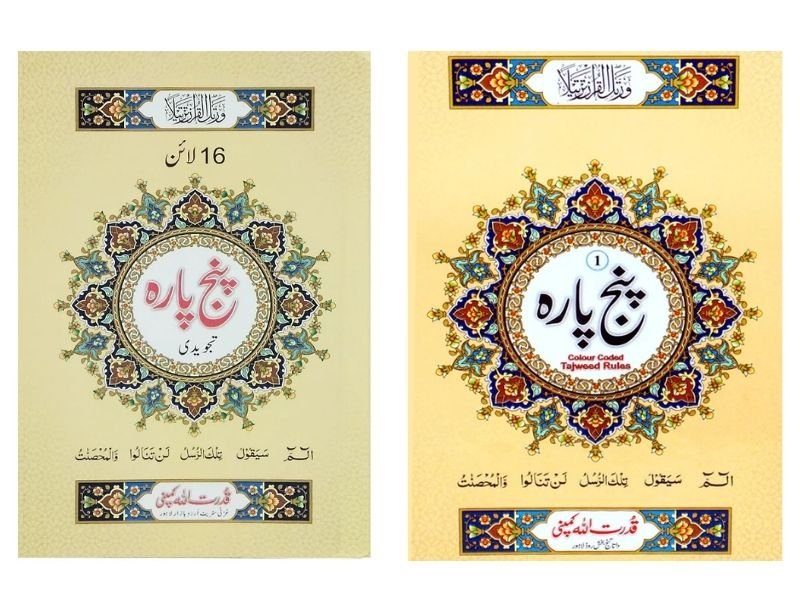
Punj Surah booklets. Contain the five most commonly recited Surahs used in Wazaif practice, including Surah Yaseen, Al-Mulk, Ar-Rahman, Al-Waqiah, and Al-Kahf.
Shahadah Surah collections. Include specific Surahs with full commentary for regular spiritual reading.
Quran Dictionary editions. Help readers understand Arabic terminology in Wazaif and Quranic verses more accurately.
Find Punj Surah booklets in our Punj Surah collection for a compact, portable format that brings the five most recited Surahs together in one beautiful booklet.
For Shahadah Surah editions, browse our Shahadah Surah collection for trusted prints used in daily Wazaif practice across Pakistani households.
Explore our Quran Dictionary collection to find reference books that help you understand the Arabic words in your daily Wazaif with clarity and confidence.
Wazaif are woven into the fabric of daily life in Pakistan. A new home is blessed with the recitation of Surah Al-Baqarah. A newborn baby receives the Adhan in the ear and Tahnik on the palate. A student facing exams recites Surah Ta-Ha or specific duas for knowledge. A sick family member receives Ruqyah with Quranic ayahs.
This tradition reflects the deep Islamic literacy that has been passed down through generations of Pakistani Muslim families. From the Mughal era scholars to the Deobandi and Barelvi traditions of the subcontinent, Wazaif have always been central to spiritual life in this region.
According to the Pew Research Centre’s Global Religious Futures study, Pakistan ranks among the top countries globally for daily religious practice, with over 93% of Pakistani Muslims reporting that religion is very important in their daily lives. Wazaif are a direct expression of this daily religious commitment. For further reading on Islamic spiritual practices and their role in Muslim communities, visit IslamQA.info, one of the most trusted online Islamic scholarly references.
If you are looking for a complete Islamic gift that includes Wazaif books, a tasbi, and prayer essentials, explore our Gift Boxes collection for thoughtfully curated sets perfect for any occasion.
A Dua is any supplication or prayer directed to Allah. It can be made at any time, in any language, and in any form. A Wazifa is a more structured form of Dua. It involves a specific recitation, a set number of repetitions, a specific time, and a specific intention. All Wazaif are forms of Dua, but not all Duas are structured Wazaif. Both are valid and important in Islam.
An authentic Wazifa can be traced back to the Quran, a Sahih hadith, or the verified compilation of a trusted Islamic scholar. It does not require forbidden actions. It does not claim guaranteed worldly results. It does not involve rituals outside of Islam. If a Wazifa cannot be verified from these sources, or if it involves harming others or committing sins, it should be avoided.
The number of repetitions depends on the specific Wazifa and its source. Some Wazaif are recited 3 times, others 7, 11, 33, 99, or 313 times, with each number having a basis in Sunnah or scholarly guidance. The most important factor is not the number but the sincerity of intention, the presence of the heart, correct pronunciation, and consistency over time.
Yes, women can recite most Wazaif during their monthly cycle with some conditions. They can recite Masnoon duas, Asmaul Husna, Durood, Istighfar, and many forms of Dhikr without restriction. However, most scholars recommend that women avoid directly touching the physical Mushaf (Quran) during this time. Reciting Quranic verses from memory or from a phone or app screen is permitted according to the majority of contemporary scholars.